

Neu
- Inhalt
- Bibliografie
- Produktsicherheit
- Zusatzmaterial
- Bewertungen (0)
- Autor*innen
- Schlagwörter
- Abstracts
Inhalt
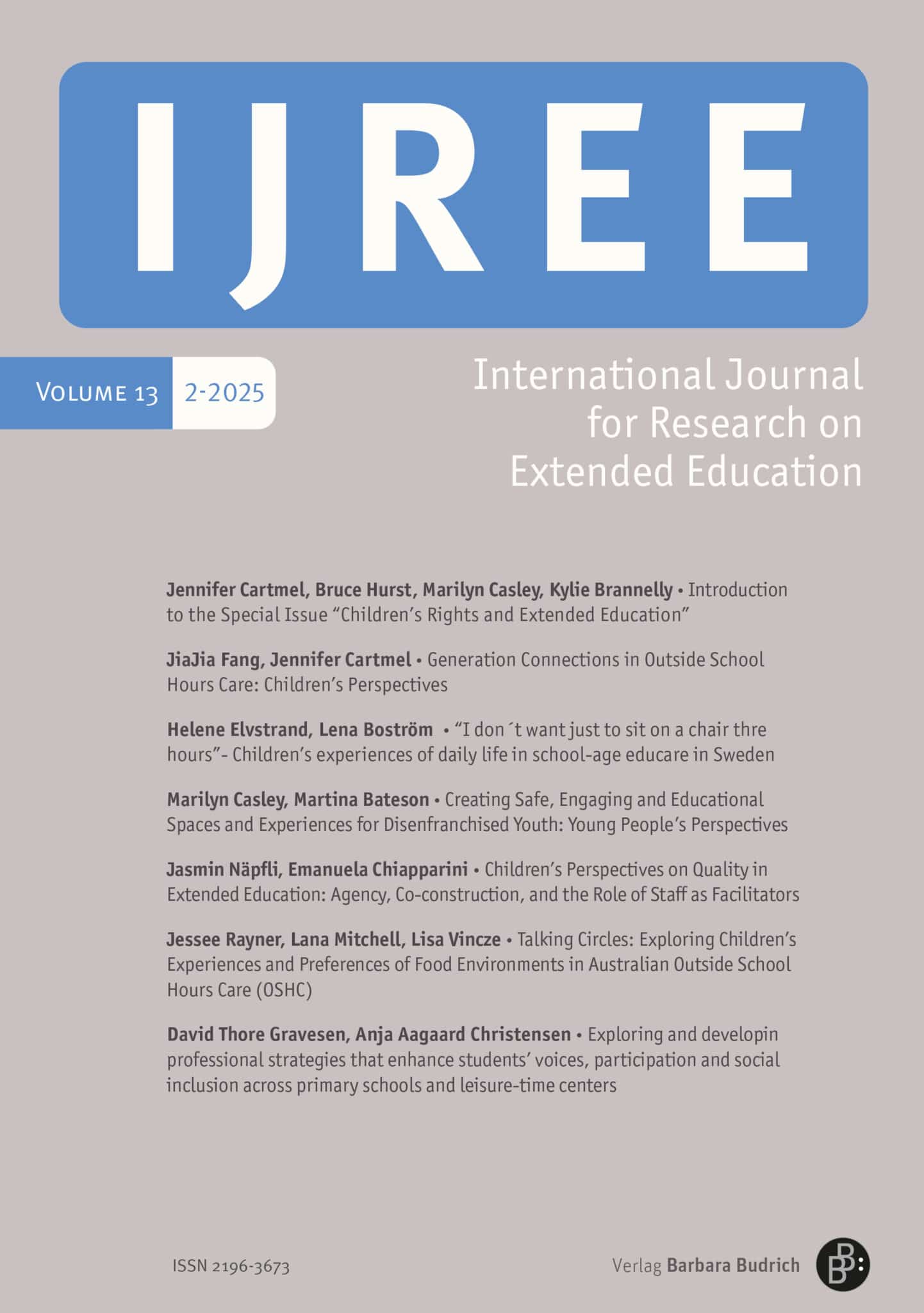
IJREE – International Journal for Research on Extended Education
2-2025: Children’s Rights and Extended Education
Sang Hoon Bae: Editor’s Preface
Special Issue
Jennifer Cartmel / Bruce Hurst / Marilyn Casley / Kylie Brannelly: Introduction to the Special Issue “Children’s Rights and Extended Education”
JiaJia Fang / Jennifer Cartmel: Generation Connections in Outside School Hours Care: Children’s Perspectives
Helene Elvstrand / Lena Boström: “I don’t want just to sit on a chair three hours” – Children’s experiences of daily life in school-age educare in Sweden
Marilyn Casley / Martina Bateson: Creating Safe, Engaging and Educational Spaces and Experiences for Disenfranchised Youth: Young People’s Perspectives
Jasmin Näpfli / Emanuela Chiapparini: Children’s Perspectives on Quality in Extended Education: Agency, Co-construction, and the Role of Staff as Facilitators
Jessee Rayner / Lana Mitchell / Lisa Vincze: Talking Circles: Exploring Children’s Experiences and Preferences of Food Environments in Australian Outside School Hours Care (OSHC)
David Thore Gravesen / Anja Aagaard Christensen: Exploring and developing professional strategies that enhance students’ voices, participation and social inclusion across primary schools and leisure-time centers
Download of single articles (Open Access/fee-based): ijree.budrich-journals.com
You can register here for the IJREE alert.
Einzelbeitrag-Download (Open Access/Gebühr): ijree.budrich-journals.com
Sie können sich hier für den IJREE-Alert anmelden.
Zusätzliche Information
| Verlag | |
|---|---|
| ISSN | 2196-3673 |
| eISSN | 2196-7423 |
| Jahrgang | 13. Jahrgang 2025 |
| Ausgabe | 2-2025 |
| Erscheinungsdatum | 18.12.2025 |
| Umfang | 124 Seiten |
| Sprache | Englisch |
| Format | 17 x 24 cm |
| DOI | |
| Homepage |
Zusatzmaterial
Table of Contents / Inhaltsverzeichnis
Extracts / Leseproben
Autor*innen
Sang Hoon Bae

Jennifer Cartmel
Bruce Hurst
Marilyn Casley
Kylie Brannelly
JiaJia Fang
Helene Elvstrand
Lena Boström
Martina Bateson
Jasmin Näpfli
Emanuela Chiapparini
Jessee Rayner
Lana Mitchell
Lisa Vincze
David Thore Gravesen
Anja Aagaard Christensen
Schlagwörteraction research, agency, child-centred approach, children and young people’s voices, children’s participation, children’s perspective, children’s perspectives, children’s rights, children’s voices, deductive analysis, Dezember 2025, disenfranchised youth, ecological systems theory, educational engagement programs, everyday practices, experience and preferences, extended education, inclusion, intergenerational program, nutrition environment, outside school hours care, outside school hours care service, participation, professionalism in extended education, quality, school age care, school-age educare, sense of coherence, socio-pedagogical user research, staff, trauma-informed practice
Abstracts
Generation Connections in Outside School Hours Care: Children’s Perspectives (JiaJia Fang, Jennifer Cartmel)
Age segregation is a significant social issue in Australia and intergenerational programs have been considered as an effective intervention to meet the needs of children and older adults. Both older community members and children are presenting unmet needs that require innovative and cost-effective care solutions. This paper focusses on the perspectives of children who participated in a series of intergenerational programs coordinated by an Outside School Hours Care (OSHC) service. Semi-structured interviews called Taking Circles were used to gather the children’s ideas and to use their perspectives for program design and innovation. The transcripts of the Talking Circles and field observations were thematically analysed. The children reported positive experiences and genuine connections developed between older adults in their community and themselves. This study is the first Australian research to explore children’s perspectives of intergenerational programs facilitated in OSHC settings. Keywords: intergenerational program, children’s participation, child-centred approach, outside school hours care service, extended education
» Download Single Contribution Free of Charge (Budrich Journals) / Einzelbeitrag kostenlos herunterladen (Budrich Journals)
“I don’t want just to sit on a chair three hours”- Children’s experiences of daily life in school-age educare in Sweden (Helene Elvstrand, Lena Boström)
The aim of this study is to contribute knowledge about how children themselves experience their daily lives in Swedish School-Age Educare (SAEC) and how these experiences can be understood in terms of comprehensibility, manageability, and meaningfulness, which are the components of Antonovsky’s (1987) Sense of Coherence theory. To gain insight into children’s perspectives, a mosaic approach was applied, allowing children to draw and participate in group discussions. The study includes 60 children from five different SAECs. The data is analysed deductively, using the three SOC components as a framework. The results reveal that the components are interconnected and affect one another. Children highlight the importance of having opportunities to play and spend time with friends. In this, teachers play a vital role, not only in providing engaging activities but also in maintaining structure, which helps children make sense of their time at the SAEC. Furthermore, the study finds that strict routines and a lack of influence can lead children to perceive their time at the SAEC as less meaningful, making it difficult to understand why certain things are done in specific ways. By applying SOC theory, the study enhances knowledge of what children consider important, ultimately contributing to a stronger sense of coherence. Key words: deductive analysis, everyday practices, children’s perspective, school-age educare, sense of coherence
» Download Single Contribution Free of Charge (Budrich Journals) / Einzelbeitrag kostenlos herunterladen (Budrich Journals)
Creating Safe, Engaging and Educational Spaces and Experiences for Disenfranchised Youth: Young People’s Perspectives (Marilyn Casley, Martina Bateson)
Participation in extended education opportunities benefits development and learning. However, an increasing number of Australian children and young people are becoming disenfranchised from formal schooling and face access barriers to extended education offerings. In this article we present and discuss the voices of young people who participated in two early intervention programs aimed at promoting positive development and psycho-socialeducational outcomes in disenfranchised youth. Their narratives demonstrate how relational, youth-centred, flexible and holistic engagement practices promote safety, trust and a sense of belonging. In the context of relational and environmental safety, participants engaged in experiences which foster development and learning and, thus, accessed their right to education. We discuss the findings drawing on trauma-informed practices, ecological systems theory and children’s rights and highlight the importance of listening to children and young people and acting on what they have to say. Keywords: Disenfranchised youth, educational engagement programs, children’s rights, trauma-informed practice, ecological systems theory, children and young people’s voices
» Download Single Contribution Free of Charge (Budrich Journals) / Einzelbeitrag kostenlos herunterladen (Budrich Journals)
Children’s Perspectives on Quality in Extended Education: Agency, Co-construction, and the Role of Staff as Facilitators (Jasmin Näpfli, Emanuela Chiapparini)
Extended Education in its current form does not always achieve the intended effects, which are closely linked to its structure and quality. While quality has often been assessed from an adult and objective perspective using predefined standards, this paper adopts a relational understanding of quality as a reflexive construct shaped through discourse and negotiation. Building on a service-theoretical approach, the focus lies on children’s perspectives to better understand the perceived benefits and uses of Extended Education. Grounded in childhood research, children are seen as experts in their own everyday experiences whose views may differ from those of adults. This paper investigates how children perceive and co-construct quality in Extended Education. Drawing on two qualitative studies with 159 primary school children and six adolescents from one Swiss canton, the paper employs photo walks, group discussions, ethnographic observations, and interviews. Thematic analysis (Braun & Clarke, 2006, 2021) was used to identify patterns across the data. Findings show that Extended Education serve as important social spaces and shape opportunities for autonomy, participation, and interaction. Children not only engage, but also resist, negotiate, or selectively participate. The ability to negotiate one’s own involvement emerges as a key quality dimension. Staff should focus on their roles as facilitators of participation and co-construction and quality assurance frameworks should move beyond structural indicators to systematically include children’s voices. Keywords: Extended Education, Quality, Children’s Perspective, Socio-Pedagogical User Research, Participation, Agency, Staff
» Download Single Contribution Free of Charge (Budrich Journals) / Einzelbeitrag kostenlos herunterladen (Budrich Journals)
Talking Circles: Exploring Children’s Experiences and Preferences of Food Environments in Australian Outside School Hours Care (OSHC) (Jessee Rayner, Lana Mitchell, Lisa Vincze)
Outside School Hours Care (OSHC) settings provide an opportunity to support children’s dietary behaviours; however, exploration of children’s food experiences within OSHC nutrition environment remains limited. Despite the crucial role nutrition plays in children’s development and their right to be involved in decision-making, their voices are often overlooked in nutrition research. Therefore, this study explored children’s experiences and preferences of the nutrition environment through semi-structured focus group discussions (i. e. Talking Circles). Twenty-nine children (aged 5–12 years) from three Queensland, Australia OSHC services participated in seven Talking Circles. Discussions were guided by a semi-structured protocol grounded in the Socio-Ecological Model of Health, and children were encouraged to share through conversations and drawings. Data were analysed using the Framework Method, revealing three key themes: [1] Food Environment, [2] Food Preferences, and [3] Nutrition Education. Findings highlighted that food is central to children’s experiences, offering nourishment, socialisation, and enjoyment; however, rigid policies and limited involvement in decision-making hinder engagement. Recommendations for future practice include involving children in food-related activities to foster the development of food agency and enhance their mealtime experiences. Alongside, greater integration of participatory approaches in nutrition research and practice to continue amplifying the voices of children. Keywords: children’s voices, nutrition environment, experience and preferences, extended education, school age care, outside school hours care.
» Download Single Contribution Free of Charge (Budrich Journals) / Einzelbeitrag kostenlos herunterladen (Budrich Journals)
Exploring and developing professional strategies that enhance students’ voices, participation and social inclusion across primary schools and leisure-time centers (David Thore Gravesen and Anja Aagaard Christensen)
This article presents findings from the Danish contribution to the Erasmus+ project Social Inclusion through Pupils’ Participation (SIPP), which aimed to enhance social inclusion in primary schools and leisure-time centers across five European countries. Focusing on The Children’s Parliament activity, the article explores how Danish pedagogues implemented child participation through Lundy’s model (space, voice, audience, influence), using an action research methodology. The analysis highlights the pedagogical challenges and opportunities in creating democratic spaces for children’s perspectives while navigating power dynamics and professional roles. Drawing on Schuepbach and Lilla’s framework for professionalism in extended education, the article discusses how inclusive and participatory practices can strengthen children’s agency, social belonging, and educators’ professional development in complex pedagogical contexts. Keywords: Inclusion, Participation, Children’s Perspectives, Professionalism in Extended Education, Action research
» Download Single Contribution Free of Charge (Budrich Journals) / Einzelbeitrag kostenlos herunterladen (Budrich Journals)
Inhalt
Inhalt
IJREE – International Journal for Research on Extended Education
2-2025: Children’s Rights and Extended Education
Sang Hoon Bae: Editor’s Preface
Special Issue
Jennifer Cartmel / Bruce Hurst / Marilyn Casley / Kylie Brannelly: Introduction to the Special Issue “Children’s Rights and Extended Education”
JiaJia Fang / Jennifer Cartmel: Generation Connections in Outside School Hours Care: Children’s Perspectives
Helene Elvstrand / Lena Boström: “I don’t want just to sit on a chair three hours” – Children’s experiences of daily life in school-age educare in Sweden
Marilyn Casley / Martina Bateson: Creating Safe, Engaging and Educational Spaces and Experiences for Disenfranchised Youth: Young People’s Perspectives
Jasmin Näpfli / Emanuela Chiapparini: Children’s Perspectives on Quality in Extended Education: Agency, Co-construction, and the Role of Staff as Facilitators
Jessee Rayner / Lana Mitchell / Lisa Vincze: Talking Circles: Exploring Children’s Experiences and Preferences of Food Environments in Australian Outside School Hours Care (OSHC)
David Thore Gravesen / Anja Aagaard Christensen: Exploring and developing professional strategies that enhance students’ voices, participation and social inclusion across primary schools and leisure-time centers
Download of single articles (Open Access/fee-based): ijree.budrich-journals.com
You can register here for the IJREE alert.
Einzelbeitrag-Download (Open Access/Gebühr): ijree.budrich-journals.com
Sie können sich hier für den IJREE-Alert anmelden.
Bibliografie
Zusätzliche Information
| Verlag | |
|---|---|
| ISSN | 2196-3673 |
| eISSN | 2196-7423 |
| Jahrgang | 13. Jahrgang 2025 |
| Ausgabe | 2-2025 |
| Erscheinungsdatum | 18.12.2025 |
| Umfang | 124 Seiten |
| Sprache | Englisch |
| Format | 17 x 24 cm |
| DOI | |
| Homepage |
Produktsicherheit
Zusatzmaterial
Zusatzmaterial
Table of Contents / Inhaltsverzeichnis
Extracts / Leseproben
Bewertungen (0)
Bewertungen
Es gibt noch keine Bewertungen.
Autor*innen
Autor*innen
Sang Hoon Bae
Jennifer Cartmel
Bruce Hurst
Marilyn Casley
Kylie Brannelly
JiaJia Fang
Helene Elvstrand
Lena Boström
Martina Bateson
Jasmin Näpfli
Emanuela Chiapparini
Jessee Rayner
Lana Mitchell
Lisa Vincze
David Thore Gravesen
Anja Aagaard Christensen
Schlagwörter
Schlagwörteraction research, agency, child-centred approach, children and young people’s voices, children’s participation, children’s perspective, children’s perspectives, children’s rights, children’s voices, deductive analysis, Dezember 2025, disenfranchised youth, ecological systems theory, educational engagement programs, everyday practices, experience and preferences, extended education, inclusion, intergenerational program, nutrition environment, outside school hours care, outside school hours care service, participation, professionalism in extended education, quality, school age care, school-age educare, sense of coherence, socio-pedagogical user research, staff, trauma-informed practice
Abstracts
Abstracts
Generation Connections in Outside School Hours Care: Children’s Perspectives (JiaJia Fang, Jennifer Cartmel)
Age segregation is a significant social issue in Australia and intergenerational programs have been considered as an effective intervention to meet the needs of children and older adults. Both older community members and children are presenting unmet needs that require innovative and cost-effective care solutions. This paper focusses on the perspectives of children who participated in a series of intergenerational programs coordinated by an Outside School Hours Care (OSHC) service. Semi-structured interviews called Taking Circles were used to gather the children’s ideas and to use their perspectives for program design and innovation. The transcripts of the Talking Circles and field observations were thematically analysed. The children reported positive experiences and genuine connections developed between older adults in their community and themselves. This study is the first Australian research to explore children’s perspectives of intergenerational programs facilitated in OSHC settings. Keywords: intergenerational program, children’s participation, child-centred approach, outside school hours care service, extended education
» Download Single Contribution Free of Charge (Budrich Journals) / Einzelbeitrag kostenlos herunterladen (Budrich Journals)
“I don’t want just to sit on a chair three hours”- Children’s experiences of daily life in school-age educare in Sweden (Helene Elvstrand, Lena Boström)
The aim of this study is to contribute knowledge about how children themselves experience their daily lives in Swedish School-Age Educare (SAEC) and how these experiences can be understood in terms of comprehensibility, manageability, and meaningfulness, which are the components of Antonovsky’s (1987) Sense of Coherence theory. To gain insight into children’s perspectives, a mosaic approach was applied, allowing children to draw and participate in group discussions. The study includes 60 children from five different SAECs. The data is analysed deductively, using the three SOC components as a framework. The results reveal that the components are interconnected and affect one another. Children highlight the importance of having opportunities to play and spend time with friends. In this, teachers play a vital role, not only in providing engaging activities but also in maintaining structure, which helps children make sense of their time at the SAEC. Furthermore, the study finds that strict routines and a lack of influence can lead children to perceive their time at the SAEC as less meaningful, making it difficult to understand why certain things are done in specific ways. By applying SOC theory, the study enhances knowledge of what children consider important, ultimately contributing to a stronger sense of coherence. Key words: deductive analysis, everyday practices, children’s perspective, school-age educare, sense of coherence
» Download Single Contribution Free of Charge (Budrich Journals) / Einzelbeitrag kostenlos herunterladen (Budrich Journals)
Creating Safe, Engaging and Educational Spaces and Experiences for Disenfranchised Youth: Young People’s Perspectives (Marilyn Casley, Martina Bateson)
Participation in extended education opportunities benefits development and learning. However, an increasing number of Australian children and young people are becoming disenfranchised from formal schooling and face access barriers to extended education offerings. In this article we present and discuss the voices of young people who participated in two early intervention programs aimed at promoting positive development and psycho-socialeducational outcomes in disenfranchised youth. Their narratives demonstrate how relational, youth-centred, flexible and holistic engagement practices promote safety, trust and a sense of belonging. In the context of relational and environmental safety, participants engaged in experiences which foster development and learning and, thus, accessed their right to education. We discuss the findings drawing on trauma-informed practices, ecological systems theory and children’s rights and highlight the importance of listening to children and young people and acting on what they have to say. Keywords: Disenfranchised youth, educational engagement programs, children’s rights, trauma-informed practice, ecological systems theory, children and young people’s voices
» Download Single Contribution Free of Charge (Budrich Journals) / Einzelbeitrag kostenlos herunterladen (Budrich Journals)
Children’s Perspectives on Quality in Extended Education: Agency, Co-construction, and the Role of Staff as Facilitators (Jasmin Näpfli, Emanuela Chiapparini)
Extended Education in its current form does not always achieve the intended effects, which are closely linked to its structure and quality. While quality has often been assessed from an adult and objective perspective using predefined standards, this paper adopts a relational understanding of quality as a reflexive construct shaped through discourse and negotiation. Building on a service-theoretical approach, the focus lies on children’s perspectives to better understand the perceived benefits and uses of Extended Education. Grounded in childhood research, children are seen as experts in their own everyday experiences whose views may differ from those of adults. This paper investigates how children perceive and co-construct quality in Extended Education. Drawing on two qualitative studies with 159 primary school children and six adolescents from one Swiss canton, the paper employs photo walks, group discussions, ethnographic observations, and interviews. Thematic analysis (Braun & Clarke, 2006, 2021) was used to identify patterns across the data. Findings show that Extended Education serve as important social spaces and shape opportunities for autonomy, participation, and interaction. Children not only engage, but also resist, negotiate, or selectively participate. The ability to negotiate one’s own involvement emerges as a key quality dimension. Staff should focus on their roles as facilitators of participation and co-construction and quality assurance frameworks should move beyond structural indicators to systematically include children’s voices. Keywords: Extended Education, Quality, Children’s Perspective, Socio-Pedagogical User Research, Participation, Agency, Staff
» Download Single Contribution Free of Charge (Budrich Journals) / Einzelbeitrag kostenlos herunterladen (Budrich Journals)
Talking Circles: Exploring Children’s Experiences and Preferences of Food Environments in Australian Outside School Hours Care (OSHC) (Jessee Rayner, Lana Mitchell, Lisa Vincze)
Outside School Hours Care (OSHC) settings provide an opportunity to support children’s dietary behaviours; however, exploration of children’s food experiences within OSHC nutrition environment remains limited. Despite the crucial role nutrition plays in children’s development and their right to be involved in decision-making, their voices are often overlooked in nutrition research. Therefore, this study explored children’s experiences and preferences of the nutrition environment through semi-structured focus group discussions (i. e. Talking Circles). Twenty-nine children (aged 5–12 years) from three Queensland, Australia OSHC services participated in seven Talking Circles. Discussions were guided by a semi-structured protocol grounded in the Socio-Ecological Model of Health, and children were encouraged to share through conversations and drawings. Data were analysed using the Framework Method, revealing three key themes: [1] Food Environment, [2] Food Preferences, and [3] Nutrition Education. Findings highlighted that food is central to children’s experiences, offering nourishment, socialisation, and enjoyment; however, rigid policies and limited involvement in decision-making hinder engagement. Recommendations for future practice include involving children in food-related activities to foster the development of food agency and enhance their mealtime experiences. Alongside, greater integration of participatory approaches in nutrition research and practice to continue amplifying the voices of children. Keywords: children’s voices, nutrition environment, experience and preferences, extended education, school age care, outside school hours care.
» Download Single Contribution Free of Charge (Budrich Journals) / Einzelbeitrag kostenlos herunterladen (Budrich Journals)
Exploring and developing professional strategies that enhance students’ voices, participation and social inclusion across primary schools and leisure-time centers (David Thore Gravesen and Anja Aagaard Christensen)
This article presents findings from the Danish contribution to the Erasmus+ project Social Inclusion through Pupils’ Participation (SIPP), which aimed to enhance social inclusion in primary schools and leisure-time centers across five European countries. Focusing on The Children’s Parliament activity, the article explores how Danish pedagogues implemented child participation through Lundy’s model (space, voice, audience, influence), using an action research methodology. The analysis highlights the pedagogical challenges and opportunities in creating democratic spaces for children’s perspectives while navigating power dynamics and professional roles. Drawing on Schuepbach and Lilla’s framework for professionalism in extended education, the article discusses how inclusive and participatory practices can strengthen children’s agency, social belonging, and educators’ professional development in complex pedagogical contexts. Keywords: Inclusion, Participation, Children’s Perspectives, Professionalism in Extended Education, Action research
» Download Single Contribution Free of Charge (Budrich Journals) / Einzelbeitrag kostenlos herunterladen (Budrich Journals)

 German
  English
Bewertungen
Es gibt noch keine Bewertungen.