

New
Inhalt
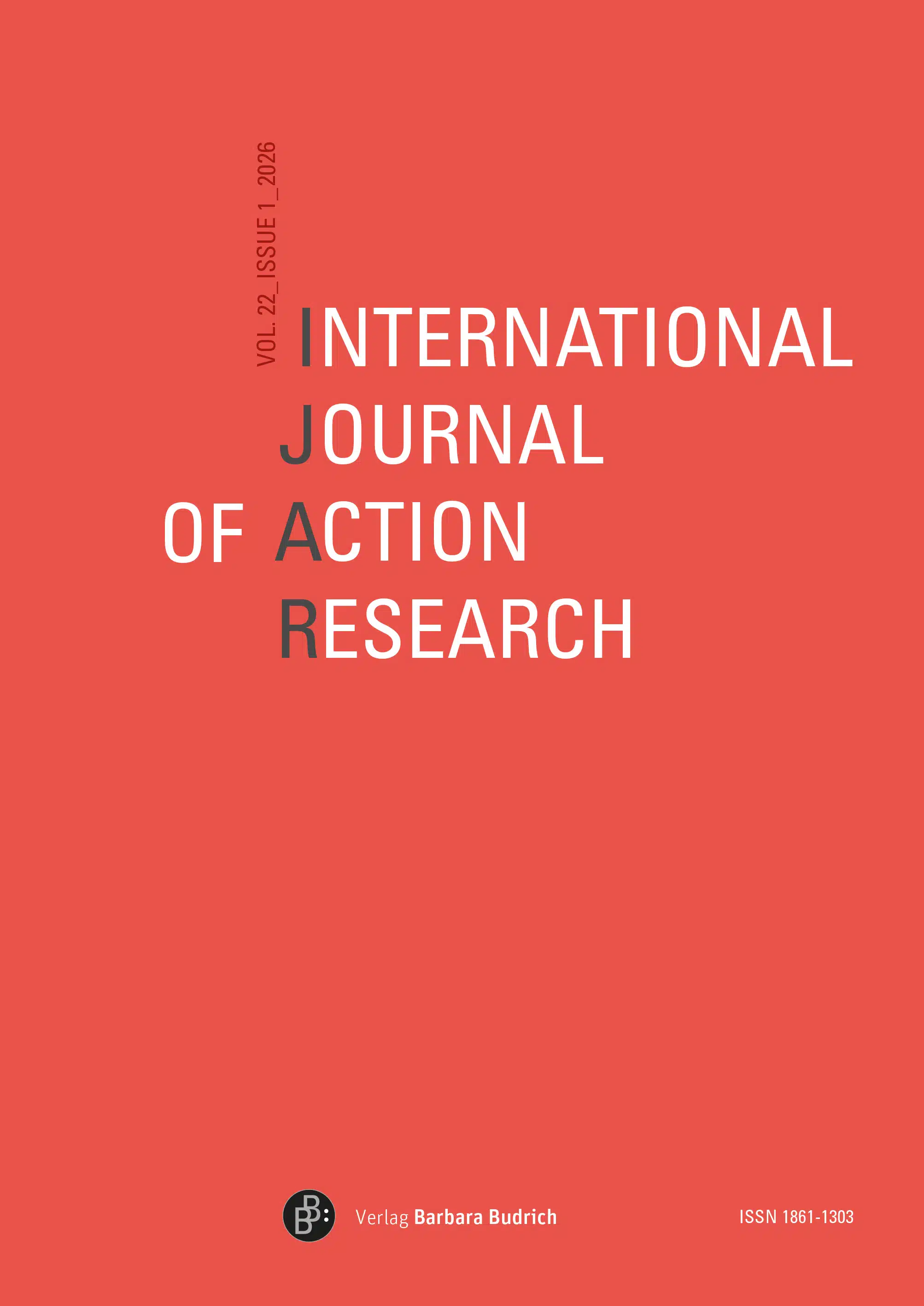
IJAR – International Journal of Action Research
1-2026: Free Contributions
Lone Hersted: Editorial
Articles
Carol Gorelick / Danny van Montfort / Freek Sanders / Tobias Fehr-Bosshard / Lone Hersted / David Coghlan: William R. Torbert’s Legacy in Transforming Doctoral Education through Collaborative Developmental Action Inquiry
Hans Christian Garmann Johnsen: Richard Ennals: An Itinerant Scholar Who Found His Home in Action Research
Amparo González Jara: Strengthening Communication and Participation among Women Smallholder Farmers: A Participatory Research Project in Yumbel, Chile
Mikel Gaztañaga Cinto: Rethinking Complexity and Facilitation in Action Research for Territorial Development: Insights from the Etorkizuna Eraikiz Think Tank in the Basque Country
Nicolas Tristan Munk / Kristian Larsen / Tom Møller / Trine Schifter Larsen: Participatory and Empowering Community Dialogue Spaces: Exploring Local Meanings of Life Quality in a Danish Community-Health Partnership (Open Access)
Book Review
Lone Hersted: Strengthening the social fabric: Action research for commoning, solidarity, mutual learning and sustainable change
Download of single articles (Open Access/fee-based): ijar.budrich-journals.com
You can register here for the IJAR alert.
Einzelbeitrag-Download (Open Access/Gebühr): ijar.budrich-journals.com
Sie können sich hier für den IJAR-Alert anmelden.
Zusätzliche Informationen
| Publisher | |
|---|---|
| ISSN | 1861-1303 |
| eISSN | 1861-9916 |
| Volume | 22. Jahrgang 2026 |
| Edition | 1-2026 |
| Date of publication | 30.07.2026 |
| Scope | 104 Seiten |
| Language | Englisch |
| Format | 17 x 24 cm |
| DOI | |
| Homepage |
Additional Content
Table of Contents / Inhaltsverzeichnis
Extracts / Leseproben
Autor*innen
Lone Hersted

Carol Gorelick
Danny van Montfort
Freek Sanders
Tobias Fehr-Bosshard
David Coghlan
Hans Christian Garmann Johnsen
Amparo González Jara
Mikel Gaztañaga Cinto
Nicolas Tristan Munk
Kristian Larsen
Tom Møller
Trine Schifter Larsen
Keywordsaction research, action research for territorial development, artificial intelligence (AI), Bill Torbert, co-generation, collaborative learning, communication, community-based, decision-making, democratic dialogue, dialogue conference, Doctoral education, epistemic translation, facilitation, intergenerational learning, Juli 2026, language games, learning from differences, participatory research, relational ethics, rural development, social engagement, territorial complexity, Wellbeing, women farmers
Abstracts
William R. Torbert’s Legacy in Transforming Doctoral Education through Collaborative Developmental Action Inquiry. An Intergenerational tribute (Carol Gorelick, Danny van Montfort, Freek Sanders, Tobias Fehr-Bosshard, Lone Hersted and David Coghlan)
This article honors the legacy of William R. Torbert (1944–2025) through an examination of his final collaborative project: a three-year initiative to reimagine doctoral education through Collaborative Developmental Action Inquiry (CDAI). Torbert’s final message, delivered three months before his death, serves as the point of departure for a reflexive exploration of an intergenerational research community of European doctoral students and faculty engaged in non-traditional action research dissertations. We show how Torbert’s concepts of first-, second-, and third-person inquiry/practice, timely action, and developmental friendship shaped our collective work and enabled a more relational, reflexive, and practice-based approach to doctoral development. By reflecting on this emergent inquiry community, we illustrate how CDAI can deepen individual research processes while also supporting institutional shifts toward more participatory and developmental forms of doctoral education. The article concludes with implications and perspectives for universities seeking to cultivate action-research-oriented doctoral cultures. Keywords: Bill Torbert, action research, collaborative learning, doctoral education, intergenerational Learning
» Buy Single Contribution (Budrich Journals) / Einzelbeitrag kaufen (Budrich Journals)
Richard Ennals: An Itinerant Scholar Who Found His Home in Action Research (Hans Christian Garmann Johnsen)
This article traces the intellectual journey of Richard Ennals, situating his wideranging work within a coherent, action-oriented framework. Although describing himself as an academic “tourist,” Ennals’ contributions reveal a consistent commitment to dialogue, social engagement, and learning across differences. Drawing on influences from Ludwig Wittgenstein, Stephen Toulmin, and Scandinavian workplace research, he developed an approach that integrates language, practice, and organisational development. His early work on socially useful artificial intelligence evolved into a focus on both tacit knowledge and language games. Through extensive collaboration in Sweden and Norway, he helped advance dialogue conferences, development coalitions, and participatory organisational change. Ennals’ later writings highlight the role of silence, denial, and performance in understanding work-life practices. The article argues that his legacy offers a powerful conceptual and methodological toolbox for contemporary action research, grounded in humanistic values, practical engagement, and a commitment to democratic dialogue. Keywords: Social engagement; artificial intelligence (AI); learning from differences; language games; democratic dialogue
» Buy Single Contribution (Budrich Journals) / Einzelbeitrag kaufen (Budrich Journals)
Strengthening Communication and Participation among Women Smallholder Farmers: A Participatory Research Project in Yumbel, Chile (Amparo González Jara)
This article examines the need to improve communication between women smallholder farmers and local authorities in Chile, a problem stemming from ineffective communication channels that restrict access to essential programs and development resources. In this article, “women smallholder farmers” refers to producers engaged in family-based smallholder agriculture, characterised by limited land size, local-scale production, and partial dependence on state support programmes provided by INDAP. The study also highlights their limited participation in local institutional decision-making spaces related to agricultural policies that directly affect their lives. Using a participatory research methodology, the women became co-creators of knowledge, actively engaging in problem identification and solution building. The process not only strengthened communication with institutions but also promoted women’s involvement in concrete decision-making spaces, such as local community councils and development committees, and fostered the emergence of community leadership roles linked to territorial representation. The findings show how participatory methodologies can contribute to more inclusive agricultural policies while addressing epistemic injustices that have historically silenced rural women. This article contributes to the international literature on participatory research by demonstrating how this approach can enhance rural women’s agency in local policy-making processes related to agricultural development. The case of Yumbel, Chile, provides insights that may inform similar initiatives in other rural contexts of the Global South. Keywords: Participatory Research, Women Farmers, Communication, Decision-Making, Rural Development
» Buy Single Contribution (Budrich Journals) / Einzelbeitrag kaufen (Budrich Journals)
Rethinking Complexity and Facilitation in Action Research for Territorial Development: Insights from the Etorkizuna Eraikiz Think Tank in the Basque Country (Mikel Gaztañaga Cinto)
This paper addresses a core challenge in Action Research for Territorial Development (ARTD) processes: the growing difficulty of building shared understanding and cogenerating knowledge among actors who operate from increasingly fragmented epistemic, ontological, and communicative frameworks. Drawing on a three-year action research process within the Etorkizuna Eraikiz Think Tank (Basque Country, Spain), it asks how can insights from the action research process in the Etorkizuna Eraikiz Think Tank contribute to refining ARTD’s approach to complexity? The paper develops two contributions: an expanded notion of complexity that includes the epistemic fragmentation and a reconceptualization of facilitation as epistemic translation. These insights aim to strengthen ARTD’s capacity to engage with fragmented territorial realities. Keywords: Action Research for Territorial Development, territorial complexity, facilitation, epistemic translation, co-generation
» Buy Single Contribution (Budrich Journals) / Einzelbeitrag kaufen (Budrich Journals)
Participatory and Empowering Community Dialogue Spaces: Exploring Local Meanings of Life Quality in a Danish Community-Health Partnership (Nicolas Tristan Munk, Kristian Larsen, Tom Møller and Trine Schifter Larsen)
This article examines how Dialogue Conferences (DCs) within the community-health project Welfare and Relations (WeARe), a partnership between two hospital institutions and a social housing organisation, contributed to locally grounded understandings of quality of life among older residents. Drawing on four Dialogue Conferences, 18 months of fieldwork, and interviews, we show how life quality emerged as a relational, situated accomplishment shaped through dialogical interaction. Residents emphasised green surroundings, mobility, safety, and small social infrastructures, while DCs enabled shared reflection and micro-practices such as coordinating outings, watching over neighbours, and initiating activities. We argue that DCs function as participatory spaces that support relational forms of empowerment through locally resonant socio-material practices. Keywords: Community-based, wellbeing, dialogue conference, relational ethics, action research
» Download Single Contribution Free of Charge (Budrich Journals) / Einzelbeitrag kostenlos herunterladen (Budrich Journals)
Inhalt
Inhalt
IJAR – International Journal of Action Research
1-2026: Free Contributions
Lone Hersted: Editorial
Articles
Carol Gorelick / Danny van Montfort / Freek Sanders / Tobias Fehr-Bosshard / Lone Hersted / David Coghlan: William R. Torbert’s Legacy in Transforming Doctoral Education through Collaborative Developmental Action Inquiry
Hans Christian Garmann Johnsen: Richard Ennals: An Itinerant Scholar Who Found His Home in Action Research
Amparo González Jara: Strengthening Communication and Participation among Women Smallholder Farmers: A Participatory Research Project in Yumbel, Chile
Mikel Gaztañaga Cinto: Rethinking Complexity and Facilitation in Action Research for Territorial Development: Insights from the Etorkizuna Eraikiz Think Tank in the Basque Country
Nicolas Tristan Munk / Kristian Larsen / Tom Møller / Trine Schifter Larsen: Participatory and Empowering Community Dialogue Spaces: Exploring Local Meanings of Life Quality in a Danish Community-Health Partnership (Open Access)
Book Review
Lone Hersted: Strengthening the social fabric: Action research for commoning, solidarity, mutual learning and sustainable change
Download of single articles (Open Access/fee-based): ijar.budrich-journals.com
You can register here for the IJAR alert.
Einzelbeitrag-Download (Open Access/Gebühr): ijar.budrich-journals.com
Sie können sich hier für den IJAR-Alert anmelden.
Bibliography
Zusätzliche Informationen
| Publisher | |
|---|---|
| ISSN | 1861-1303 |
| eISSN | 1861-9916 |
| Volume | 22. Jahrgang 2026 |
| Edition | 1-2026 |
| Date of publication | 30.07.2026 |
| Scope | 104 Seiten |
| Language | Englisch |
| Format | 17 x 24 cm |
| DOI | |
| Homepage |
Produktsicherheit
Additional Content
Additional Content
Table of Contents / Inhaltsverzeichnis
Extracts / Leseproben
Bewertungen (0)
Bewertungen
Es gibt noch keine Bewertungen.
Authors
Autor*innen
Lone Hersted
Carol Gorelick
Danny van Montfort
Freek Sanders
Tobias Fehr-Bosshard
David Coghlan
Hans Christian Garmann Johnsen
Amparo González Jara
Mikel Gaztañaga Cinto
Nicolas Tristan Munk
Kristian Larsen
Tom Møller
Trine Schifter Larsen
Tags
Keywordsaction research, action research for territorial development, artificial intelligence (AI), Bill Torbert, co-generation, collaborative learning, communication, community-based, decision-making, democratic dialogue, dialogue conference, Doctoral education, epistemic translation, facilitation, intergenerational learning, Juli 2026, language games, learning from differences, participatory research, relational ethics, rural development, social engagement, territorial complexity, Wellbeing, women farmers
Abstracts
Abstracts
William R. Torbert’s Legacy in Transforming Doctoral Education through Collaborative Developmental Action Inquiry. An Intergenerational tribute (Carol Gorelick, Danny van Montfort, Freek Sanders, Tobias Fehr-Bosshard, Lone Hersted and David Coghlan)
This article honors the legacy of William R. Torbert (1944–2025) through an examination of his final collaborative project: a three-year initiative to reimagine doctoral education through Collaborative Developmental Action Inquiry (CDAI). Torbert’s final message, delivered three months before his death, serves as the point of departure for a reflexive exploration of an intergenerational research community of European doctoral students and faculty engaged in non-traditional action research dissertations. We show how Torbert’s concepts of first-, second-, and third-person inquiry/practice, timely action, and developmental friendship shaped our collective work and enabled a more relational, reflexive, and practice-based approach to doctoral development. By reflecting on this emergent inquiry community, we illustrate how CDAI can deepen individual research processes while also supporting institutional shifts toward more participatory and developmental forms of doctoral education. The article concludes with implications and perspectives for universities seeking to cultivate action-research-oriented doctoral cultures. Keywords: Bill Torbert, action research, collaborative learning, doctoral education, intergenerational Learning
» Buy Single Contribution (Budrich Journals) / Einzelbeitrag kaufen (Budrich Journals)
Richard Ennals: An Itinerant Scholar Who Found His Home in Action Research (Hans Christian Garmann Johnsen)
This article traces the intellectual journey of Richard Ennals, situating his wideranging work within a coherent, action-oriented framework. Although describing himself as an academic “tourist,” Ennals’ contributions reveal a consistent commitment to dialogue, social engagement, and learning across differences. Drawing on influences from Ludwig Wittgenstein, Stephen Toulmin, and Scandinavian workplace research, he developed an approach that integrates language, practice, and organisational development. His early work on socially useful artificial intelligence evolved into a focus on both tacit knowledge and language games. Through extensive collaboration in Sweden and Norway, he helped advance dialogue conferences, development coalitions, and participatory organisational change. Ennals’ later writings highlight the role of silence, denial, and performance in understanding work-life practices. The article argues that his legacy offers a powerful conceptual and methodological toolbox for contemporary action research, grounded in humanistic values, practical engagement, and a commitment to democratic dialogue. Keywords: Social engagement; artificial intelligence (AI); learning from differences; language games; democratic dialogue
» Buy Single Contribution (Budrich Journals) / Einzelbeitrag kaufen (Budrich Journals)
Strengthening Communication and Participation among Women Smallholder Farmers: A Participatory Research Project in Yumbel, Chile (Amparo González Jara)
This article examines the need to improve communication between women smallholder farmers and local authorities in Chile, a problem stemming from ineffective communication channels that restrict access to essential programs and development resources. In this article, “women smallholder farmers” refers to producers engaged in family-based smallholder agriculture, characterised by limited land size, local-scale production, and partial dependence on state support programmes provided by INDAP. The study also highlights their limited participation in local institutional decision-making spaces related to agricultural policies that directly affect their lives. Using a participatory research methodology, the women became co-creators of knowledge, actively engaging in problem identification and solution building. The process not only strengthened communication with institutions but also promoted women’s involvement in concrete decision-making spaces, such as local community councils and development committees, and fostered the emergence of community leadership roles linked to territorial representation. The findings show how participatory methodologies can contribute to more inclusive agricultural policies while addressing epistemic injustices that have historically silenced rural women. This article contributes to the international literature on participatory research by demonstrating how this approach can enhance rural women’s agency in local policy-making processes related to agricultural development. The case of Yumbel, Chile, provides insights that may inform similar initiatives in other rural contexts of the Global South. Keywords: Participatory Research, Women Farmers, Communication, Decision-Making, Rural Development
» Buy Single Contribution (Budrich Journals) / Einzelbeitrag kaufen (Budrich Journals)
Rethinking Complexity and Facilitation in Action Research for Territorial Development: Insights from the Etorkizuna Eraikiz Think Tank in the Basque Country (Mikel Gaztañaga Cinto)
This paper addresses a core challenge in Action Research for Territorial Development (ARTD) processes: the growing difficulty of building shared understanding and cogenerating knowledge among actors who operate from increasingly fragmented epistemic, ontological, and communicative frameworks. Drawing on a three-year action research process within the Etorkizuna Eraikiz Think Tank (Basque Country, Spain), it asks how can insights from the action research process in the Etorkizuna Eraikiz Think Tank contribute to refining ARTD’s approach to complexity? The paper develops two contributions: an expanded notion of complexity that includes the epistemic fragmentation and a reconceptualization of facilitation as epistemic translation. These insights aim to strengthen ARTD’s capacity to engage with fragmented territorial realities. Keywords: Action Research for Territorial Development, territorial complexity, facilitation, epistemic translation, co-generation
» Buy Single Contribution (Budrich Journals) / Einzelbeitrag kaufen (Budrich Journals)
Participatory and Empowering Community Dialogue Spaces: Exploring Local Meanings of Life Quality in a Danish Community-Health Partnership (Nicolas Tristan Munk, Kristian Larsen, Tom Møller and Trine Schifter Larsen)
This article examines how Dialogue Conferences (DCs) within the community-health project Welfare and Relations (WeARe), a partnership between two hospital institutions and a social housing organisation, contributed to locally grounded understandings of quality of life among older residents. Drawing on four Dialogue Conferences, 18 months of fieldwork, and interviews, we show how life quality emerged as a relational, situated accomplishment shaped through dialogical interaction. Residents emphasised green surroundings, mobility, safety, and small social infrastructures, while DCs enabled shared reflection and micro-practices such as coordinating outings, watching over neighbours, and initiating activities. We argue that DCs function as participatory spaces that support relational forms of empowerment through locally resonant socio-material practices. Keywords: Community-based, wellbeing, dialogue conference, relational ethics, action research
» Download Single Contribution Free of Charge (Budrich Journals) / Einzelbeitrag kostenlos herunterladen (Budrich Journals)
 English
  German
Bewertungen
Es gibt noch keine Bewertungen.