

New
Inhalt
IJREE – International Journal for Research on Extended Education
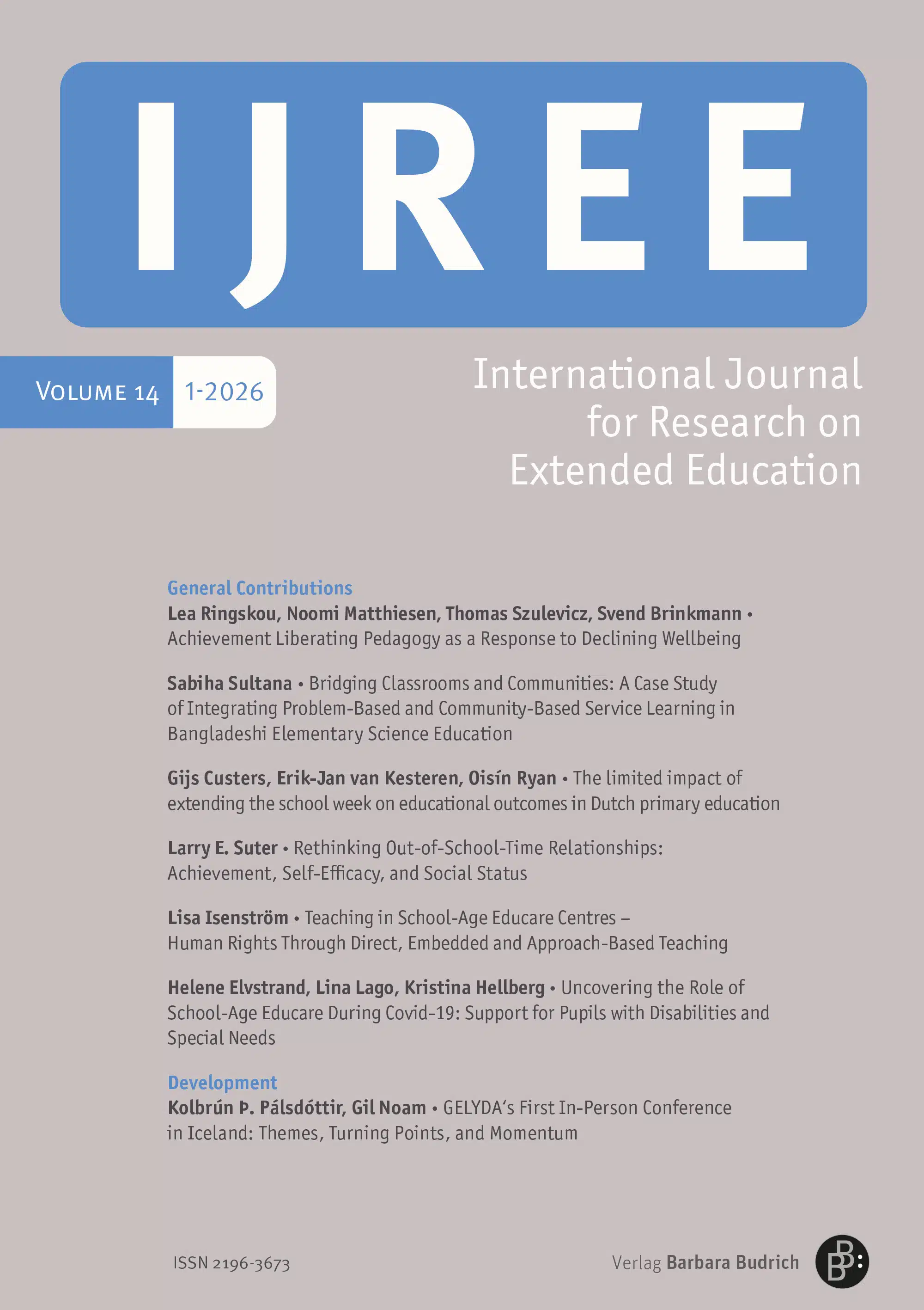
1-2026: Free Contributions
Sang Hoon Bae: Preface
General Contributions
Sabiha Sultana: Bridging Classrooms and Communities: A Case Study of Integrating Problem-Based and Community-Based Service Learning in Bangladeshi Elementary Science Education
Lea Ringskou / Noomi Matthiesen / Thomas Szulevicz / Svend Brinkmann: Achievement Liberating Pedagogy as a Response to Declining Wellbeing
Gijs Custers / Erik-Jan van Kesteren / Oisín Ryan: The Limited Impact of Extending the School Week on Educational Outcomes in Dutch Primary Education: a Quasi-Experimental Study Using Penalized Synthetic Control Analysis
Lisa Isenström: Teaching in School-Age Educare Centres – Human Rights Through Direct, Embedded and Approach-Based Teaching
Larry E. Suter: Rethinking Out-of-School-Time Relationships: Achievement, Self-Efficacy, and Social Status
Helene Elvstrand / Lina Lago / Kristina Hellberg: Uncovering the Role of School-Age Educare During Covid-19: Support for Pupils with Disabilities and Special Needs
Development
Kolbrún Þ. Pálsdóttir / Gil Noam: GELYDA’s First In-Person Conference in Iceland: Themes, Turning Points, and Momentum
Download of single articles (Open Access/fee-based): ijree.budrich-journals.com
You can register here for the IJREE alert.
Einzelbeitrag-Download (Open Access/Gebühr): ijree.budrich-journals.com
Sie können sich hier für den IJREE-Alert anmelden.
Zusätzliche Informationen
| Publisher | |
|---|---|
| ISSN | 2196-3673 |
| eISSN | 2196-7423 |
| Volume | 14. Jahrgang 2026 |
| Edition | 1-2026 |
| Date of publication | 09.09.2026 |
| Scope | 148 Seiten |
| Language | Englisch |
| Format | 17 x 24 cm |
| DOI | |
| Homepage |
Additional Content
Table of Contents / Inhaltsverzeichnis
Extracts / Leseproben
Autor*innen
Sang Hoon Bae

Sabiha Sultana
Lea Ringskou
Noomi Matthiesen
Thomas Szulevicz
Svend Brinkmann
Gijs Custers
Erik-Jan van Kesteren
Oisín Ryan
Lisa Isenström
Larry E. Suter
Helene Elvstrand
Lina Lago
Kristina Hellberg
Kolbrún Þ. Pálsdóttir
Gil Noam
Keywordsachievement liberating pedagogy, achievement society, achievement subject, after-school programs, attitudes, Bangladeshi elementary education, children’s rights, community-based learning, Covid-19 pandemic, disabilities, educational effectiveness, extended education, extended school time, gain scores, Global Extended Learning and Youth Development Association (GELYDA), Harlem Children’s Zone, human rights, leisure time pedagogy, out-of-school time, problem-based learning, professional claims, SAEC, school-age educare, September 2026, service learning, social status, special educational needs, student achievement, synthetic control method, Teaching, tutoring, Wellbeing
Abstracts
Bridging Classrooms and Communities: A Case Study of Integrating Problem-Based and Community-Based Service Learning in Bangladeshi Elementary Science Education (Sabiha Sultana)
In this study, I explore how integrating problem-based learning with community-based service learning fosters 21st-century skills—specifically communication, collaboration, and critical thinking—among Bangladeshi elementary students. Drawing on a multi-stakeholder, participatory learning design process involving teachers, students, parents, teacher trainers, and education policymakers, I investigate the impact of a community engagement learning model developed and implemented across rural and urban public schools in Bangladesh. Using case study methodology, I analyzed data from classroom observations, student-led community projects, interviews, focus groups, and over 288 self-assessment survey responses. Findings demonstrate that embedding experiential, socially relevant learning activities into science curriculum enhanced students’ ability to articulate ideas, work collaboratively, and critically engage with socioscientific issues. The study provides empirical evidence of how localized service learning grounded in students’ lived experiences can challenge epistemic injustice and support educational transformation in Global South contexts. Implications are discussed for curricular innovation, teacher development, and educational policy in resource-constrained environments. Keywords: problem-based learning, service learning, Bangladeshi elementary education, community-based learning
» Buy Single Contribution (Budrich Journals) / Einzelbeitrag kaufen (Budrich Journals)
Achievement Liberating Pedagogy as a Response to Declining Wellbeing (Lea Ringskou, Noomi Matthiesen, Thomas Szulevicz, Svend Brinkmann)
The aim of this article is to articulate the contours of an achievement liberating pedagogy as a response to a general decrease in wellbeing among children and young people in Denmark. The analysis is based on a research project conducted in leisure time centers and youth clubs. The decrease in wellbeing is complex but nevertheless calls for pedagogical and institutional action. We argue that the achievement society can be seen as one explanation of the decrease in wellbeing. We propose that an achievement liberating pedagogy can be a pedagogical response to the negative consequences of an achievement society. Achievement liberating pedagogy is a world-centered pedagogy based on practices that unfold in both structured and spontaneous activities. It involves a pedagogical intention of liberation from instrumental and result-oriented activities, from individual measurements and from self-optimization. Instead, it aims to direct the pedagogical telos away from individual achievement, towards communities and joint activities engaged in for their own sake. Based on empirical findings, we draw the contours of achievement liberating pedagogy, its pitfalls and conditions that can challenge it. The analysis is based on theoretical inspiration from Hartmut Rosa’s theory of resonance and Max Van Manen’s analysis of pedagogical tact. Keywords: wellbeing, achievement society, achievement subject, achievement liberating pedagogy, leisure time pedagogy, professional claims
» Buy Single Contribution (Budrich Journals) / Einzelbeitrag kaufen (Budrich Journals)
The Limited Impact of Extending the School Week on Educational Outcomes in Dutch Primary Education: a Quasi-Experimental Study Using Penalized Synthetic Control Analysis (Gijs Custers, Erik-Jan van Kesteren, Oisín Ryan)
This study uses a quasi-experimental design to investigate the causal impact of an extended school week on educational performance in 22 Dutch primary schools. The intervention has been partly modeled after the prominent Harlem Children’s Zone (HCZ). To assess the impact of the intervention, we leverage register data containing information on all Dutch children finishing primary school in the period 2009–2022. Synthetic control analysis is applied to estimate the causal effect for each individual school. The findings show the program has had limited effect on educational outcomes with little variation between schools. Although we lack implementation measures, we discuss how factors such as goal switching, lack of participation, and teacher shortages may have hampered program effectiveness. Finally, we explore whether the HCZ concept is transferable to other international contexts. Keywords: Educational effectiveness; extended school time; after-school programs; Harlem Children’s Zone; synthetic control method
» Buy Single Contribution (Budrich Journals) / Einzelbeitrag kaufen (Budrich Journals)
Teaching in School-Age Educare Centres – Human Rights Through Direct, Embedded and Approach-Based Teaching (Lisa Isenström)
This article examines how teaching is enacted in extended education settings, using Swedish school-age educare (SAEC) centres and human rights as examples. It analyses SAEC teachers’ discussions about content and methods in this practice area. The article is based on interview data from 19 SAEC teachers in Sweden. The data were analysed through content analysis, theoretically framed within an action-theoretical approach and employing three theoretical teaching types: direct teaching, embedded teaching, and approach-based teaching. The findings demonstrate how each teaching type addresses different content with distinct methods, as: a) direct teaching prioritises knowledge development through a variety of methods, b) embedded teaching prioritises conduct development through conversations, and c) approach-based teaching prioritises acquiring rights experiences through teachers’ different ways of managing situations. Therefore, the findings suggest that SAEC teachers need opportunities for and competence in all three teaching types to cover a broad range of educational topics and to fully utilise the potential of extended education contexts for teaching and learning. Keywords: Extended education, school-age educare, SAEC, teaching, human rights, children’s Rights
» Buy Single Contribution (Budrich Journals) / Einzelbeitrag kaufen (Budrich Journals)
Rethinking Out-of-School-Time Relationships: Achievement, Self-Efficacy, and Social Status (Larry E. Suter)
The analysis describes how participation in outside-school-time (OST) activities and tutoring of the U.S. high school student population was associated with algebra achievement and mathematics self-efficacy. The complex dynamics between factors associated with OST and students’ backgrounds were explored in detail with descriptive displays and regression models. The survey analysis found that the probability of high school students participating in informal activities was associated with both family social status and prior (9th grade) achievement equally. Participating with a tutor was found not to be associated with student’s algebra achievement and self-efficacy by 11th grade. Student participation in multiple OST activities (clubs, study groups, college preparation classes, and more) was positively associated with higher self-efficacy in mathematics but not with achievement. The resulting analysis provides insights that sharpen our understanding of how to describe the integration of student OST experiences and academic outcomes. The resulting empirical evidence lends support to the need for incorporating interactions between ability, social status, and study time in research studies intending to identify causal effects of extended study. Keywords: Tutoring, out-of-school-time, social status, student achievement, attitudes, gain Scores
» Buy Single Contribution (Budrich Journals) / Einzelbeitrag kaufen (Budrich Journals)
Uncovering the Role of School-Age Educare During the Covid-19 pandemic: Support for Pupils with Disabilities and Special Needs (Helene Elvstrand, Lina Lago, Kristina Hellberg)
This study examines the challenges that school-age educare (SAEC) staff faced during the Covid-19 pandemic, with a particular focus on support provided to pupils with disabilities and special educational needs. The empirical material consists of qualitative interviews with staff from compulsory schools and special needs compulsory schools. In total, 19 interviews were conducted, ten individual and nine group interviews, comprising a total of 39 informants. The study draws on symbolic interactionism and the framework of inhabited institutions. The analysis was carried out using constructivist grounded theory as the methodological approach. The findings indicates that SAEC staff often work across both school and SAEC, acting as a consistent link across pupils’ daily activities and making them pivotal in shaping pupils’ everyday experiences and support structures. This positions them as central actors in pupils’ lives. During the pandemic, extensive organisational changes challenged SAEC’s mission to offer alternative practices and experiences, as restrictions made collaboration between groups and school forms impossible. Furthermore, SAEC’s role as a meeting and transition place was undermined by high teacher absenteeism and the prohibition of parental access to school premises. For pupils in need of support, these circumstances created significant difficulties for SAEC in providing adequate assistance and in maintaining a holistic approach to pupils’ needs. Keywords: Covid-19 pandemic, disabilities, school-age educare, special educational needs
» Buy Single Contribution (Budrich Journals) / Einzelbeitrag kaufen (Budrich Journals)
Inhalt
Inhalt
IJREE – International Journal for Research on Extended Education
1-2026: Free Contributions
Sang Hoon Bae: Preface
General Contributions
Sabiha Sultana: Bridging Classrooms and Communities: A Case Study of Integrating Problem-Based and Community-Based Service Learning in Bangladeshi Elementary Science Education
Lea Ringskou / Noomi Matthiesen / Thomas Szulevicz / Svend Brinkmann: Achievement Liberating Pedagogy as a Response to Declining Wellbeing
Gijs Custers / Erik-Jan van Kesteren / Oisín Ryan: The Limited Impact of Extending the School Week on Educational Outcomes in Dutch Primary Education: a Quasi-Experimental Study Using Penalized Synthetic Control Analysis
Lisa Isenström: Teaching in School-Age Educare Centres – Human Rights Through Direct, Embedded and Approach-Based Teaching
Larry E. Suter: Rethinking Out-of-School-Time Relationships: Achievement, Self-Efficacy, and Social Status
Helene Elvstrand / Lina Lago / Kristina Hellberg: Uncovering the Role of School-Age Educare During Covid-19: Support for Pupils with Disabilities and Special Needs
Development
Kolbrún Þ. Pálsdóttir / Gil Noam: GELYDA’s First In-Person Conference in Iceland: Themes, Turning Points, and Momentum
Download of single articles (Open Access/fee-based): ijree.budrich-journals.com
You can register here for the IJREE alert.
Einzelbeitrag-Download (Open Access/Gebühr): ijree.budrich-journals.com
Sie können sich hier für den IJREE-Alert anmelden.
Bibliography
Zusätzliche Informationen
| Publisher | |
|---|---|
| ISSN | 2196-3673 |
| eISSN | 2196-7423 |
| Volume | 14. Jahrgang 2026 |
| Edition | 1-2026 |
| Date of publication | 09.09.2026 |
| Scope | 148 Seiten |
| Language | Englisch |
| Format | 17 x 24 cm |
| DOI | |
| Homepage |
Produktsicherheit
Additional Content
Additional Content
Table of Contents / Inhaltsverzeichnis
Extracts / Leseproben
Bewertungen (0)
Bewertungen
Es gibt noch keine Bewertungen.
Authors
Autor*innen
Sang Hoon Bae
Sabiha Sultana
Lea Ringskou
Noomi Matthiesen
Thomas Szulevicz
Svend Brinkmann
Gijs Custers
Erik-Jan van Kesteren
Oisín Ryan
Lisa Isenström
Larry E. Suter
Helene Elvstrand
Lina Lago
Kristina Hellberg
Kolbrún Þ. Pálsdóttir
Gil Noam
Tags
Keywordsachievement liberating pedagogy, achievement society, achievement subject, after-school programs, attitudes, Bangladeshi elementary education, children’s rights, community-based learning, Covid-19 pandemic, disabilities, educational effectiveness, extended education, extended school time, gain scores, Global Extended Learning and Youth Development Association (GELYDA), Harlem Children’s Zone, human rights, leisure time pedagogy, out-of-school time, problem-based learning, professional claims, SAEC, school-age educare, September 2026, service learning, social status, special educational needs, student achievement, synthetic control method, Teaching, tutoring, Wellbeing
Abstracts
Abstracts
Bridging Classrooms and Communities: A Case Study of Integrating Problem-Based and Community-Based Service Learning in Bangladeshi Elementary Science Education (Sabiha Sultana)
In this study, I explore how integrating problem-based learning with community-based service learning fosters 21st-century skills—specifically communication, collaboration, and critical thinking—among Bangladeshi elementary students. Drawing on a multi-stakeholder, participatory learning design process involving teachers, students, parents, teacher trainers, and education policymakers, I investigate the impact of a community engagement learning model developed and implemented across rural and urban public schools in Bangladesh. Using case study methodology, I analyzed data from classroom observations, student-led community projects, interviews, focus groups, and over 288 self-assessment survey responses. Findings demonstrate that embedding experiential, socially relevant learning activities into science curriculum enhanced students’ ability to articulate ideas, work collaboratively, and critically engage with socioscientific issues. The study provides empirical evidence of how localized service learning grounded in students’ lived experiences can challenge epistemic injustice and support educational transformation in Global South contexts. Implications are discussed for curricular innovation, teacher development, and educational policy in resource-constrained environments. Keywords: problem-based learning, service learning, Bangladeshi elementary education, community-based learning
» Buy Single Contribution (Budrich Journals) / Einzelbeitrag kaufen (Budrich Journals)
Achievement Liberating Pedagogy as a Response to Declining Wellbeing (Lea Ringskou, Noomi Matthiesen, Thomas Szulevicz, Svend Brinkmann)
The aim of this article is to articulate the contours of an achievement liberating pedagogy as a response to a general decrease in wellbeing among children and young people in Denmark. The analysis is based on a research project conducted in leisure time centers and youth clubs. The decrease in wellbeing is complex but nevertheless calls for pedagogical and institutional action. We argue that the achievement society can be seen as one explanation of the decrease in wellbeing. We propose that an achievement liberating pedagogy can be a pedagogical response to the negative consequences of an achievement society. Achievement liberating pedagogy is a world-centered pedagogy based on practices that unfold in both structured and spontaneous activities. It involves a pedagogical intention of liberation from instrumental and result-oriented activities, from individual measurements and from self-optimization. Instead, it aims to direct the pedagogical telos away from individual achievement, towards communities and joint activities engaged in for their own sake. Based on empirical findings, we draw the contours of achievement liberating pedagogy, its pitfalls and conditions that can challenge it. The analysis is based on theoretical inspiration from Hartmut Rosa’s theory of resonance and Max Van Manen’s analysis of pedagogical tact. Keywords: wellbeing, achievement society, achievement subject, achievement liberating pedagogy, leisure time pedagogy, professional claims
» Buy Single Contribution (Budrich Journals) / Einzelbeitrag kaufen (Budrich Journals)
The Limited Impact of Extending the School Week on Educational Outcomes in Dutch Primary Education: a Quasi-Experimental Study Using Penalized Synthetic Control Analysis (Gijs Custers, Erik-Jan van Kesteren, Oisín Ryan)
This study uses a quasi-experimental design to investigate the causal impact of an extended school week on educational performance in 22 Dutch primary schools. The intervention has been partly modeled after the prominent Harlem Children’s Zone (HCZ). To assess the impact of the intervention, we leverage register data containing information on all Dutch children finishing primary school in the period 2009–2022. Synthetic control analysis is applied to estimate the causal effect for each individual school. The findings show the program has had limited effect on educational outcomes with little variation between schools. Although we lack implementation measures, we discuss how factors such as goal switching, lack of participation, and teacher shortages may have hampered program effectiveness. Finally, we explore whether the HCZ concept is transferable to other international contexts. Keywords: Educational effectiveness; extended school time; after-school programs; Harlem Children’s Zone; synthetic control method
» Buy Single Contribution (Budrich Journals) / Einzelbeitrag kaufen (Budrich Journals)
Teaching in School-Age Educare Centres – Human Rights Through Direct, Embedded and Approach-Based Teaching (Lisa Isenström)
This article examines how teaching is enacted in extended education settings, using Swedish school-age educare (SAEC) centres and human rights as examples. It analyses SAEC teachers’ discussions about content and methods in this practice area. The article is based on interview data from 19 SAEC teachers in Sweden. The data were analysed through content analysis, theoretically framed within an action-theoretical approach and employing three theoretical teaching types: direct teaching, embedded teaching, and approach-based teaching. The findings demonstrate how each teaching type addresses different content with distinct methods, as: a) direct teaching prioritises knowledge development through a variety of methods, b) embedded teaching prioritises conduct development through conversations, and c) approach-based teaching prioritises acquiring rights experiences through teachers’ different ways of managing situations. Therefore, the findings suggest that SAEC teachers need opportunities for and competence in all three teaching types to cover a broad range of educational topics and to fully utilise the potential of extended education contexts for teaching and learning. Keywords: Extended education, school-age educare, SAEC, teaching, human rights, children’s Rights
» Buy Single Contribution (Budrich Journals) / Einzelbeitrag kaufen (Budrich Journals)
Rethinking Out-of-School-Time Relationships: Achievement, Self-Efficacy, and Social Status (Larry E. Suter)
The analysis describes how participation in outside-school-time (OST) activities and tutoring of the U.S. high school student population was associated with algebra achievement and mathematics self-efficacy. The complex dynamics between factors associated with OST and students’ backgrounds were explored in detail with descriptive displays and regression models. The survey analysis found that the probability of high school students participating in informal activities was associated with both family social status and prior (9th grade) achievement equally. Participating with a tutor was found not to be associated with student’s algebra achievement and self-efficacy by 11th grade. Student participation in multiple OST activities (clubs, study groups, college preparation classes, and more) was positively associated with higher self-efficacy in mathematics but not with achievement. The resulting analysis provides insights that sharpen our understanding of how to describe the integration of student OST experiences and academic outcomes. The resulting empirical evidence lends support to the need for incorporating interactions between ability, social status, and study time in research studies intending to identify causal effects of extended study. Keywords: Tutoring, out-of-school-time, social status, student achievement, attitudes, gain Scores
» Buy Single Contribution (Budrich Journals) / Einzelbeitrag kaufen (Budrich Journals)
Uncovering the Role of School-Age Educare During the Covid-19 pandemic: Support for Pupils with Disabilities and Special Needs (Helene Elvstrand, Lina Lago, Kristina Hellberg)
This study examines the challenges that school-age educare (SAEC) staff faced during the Covid-19 pandemic, with a particular focus on support provided to pupils with disabilities and special educational needs. The empirical material consists of qualitative interviews with staff from compulsory schools and special needs compulsory schools. In total, 19 interviews were conducted, ten individual and nine group interviews, comprising a total of 39 informants. The study draws on symbolic interactionism and the framework of inhabited institutions. The analysis was carried out using constructivist grounded theory as the methodological approach. The findings indicates that SAEC staff often work across both school and SAEC, acting as a consistent link across pupils’ daily activities and making them pivotal in shaping pupils’ everyday experiences and support structures. This positions them as central actors in pupils’ lives. During the pandemic, extensive organisational changes challenged SAEC’s mission to offer alternative practices and experiences, as restrictions made collaboration between groups and school forms impossible. Furthermore, SAEC’s role as a meeting and transition place was undermined by high teacher absenteeism and the prohibition of parental access to school premises. For pupils in need of support, these circumstances created significant difficulties for SAEC in providing adequate assistance and in maintaining a holistic approach to pupils’ needs. Keywords: Covid-19 pandemic, disabilities, school-age educare, special educational needs
» Buy Single Contribution (Budrich Journals) / Einzelbeitrag kaufen (Budrich Journals)

 English
  German
Bewertungen
Es gibt noch keine Bewertungen.