

New
Inhalt
Educational Science
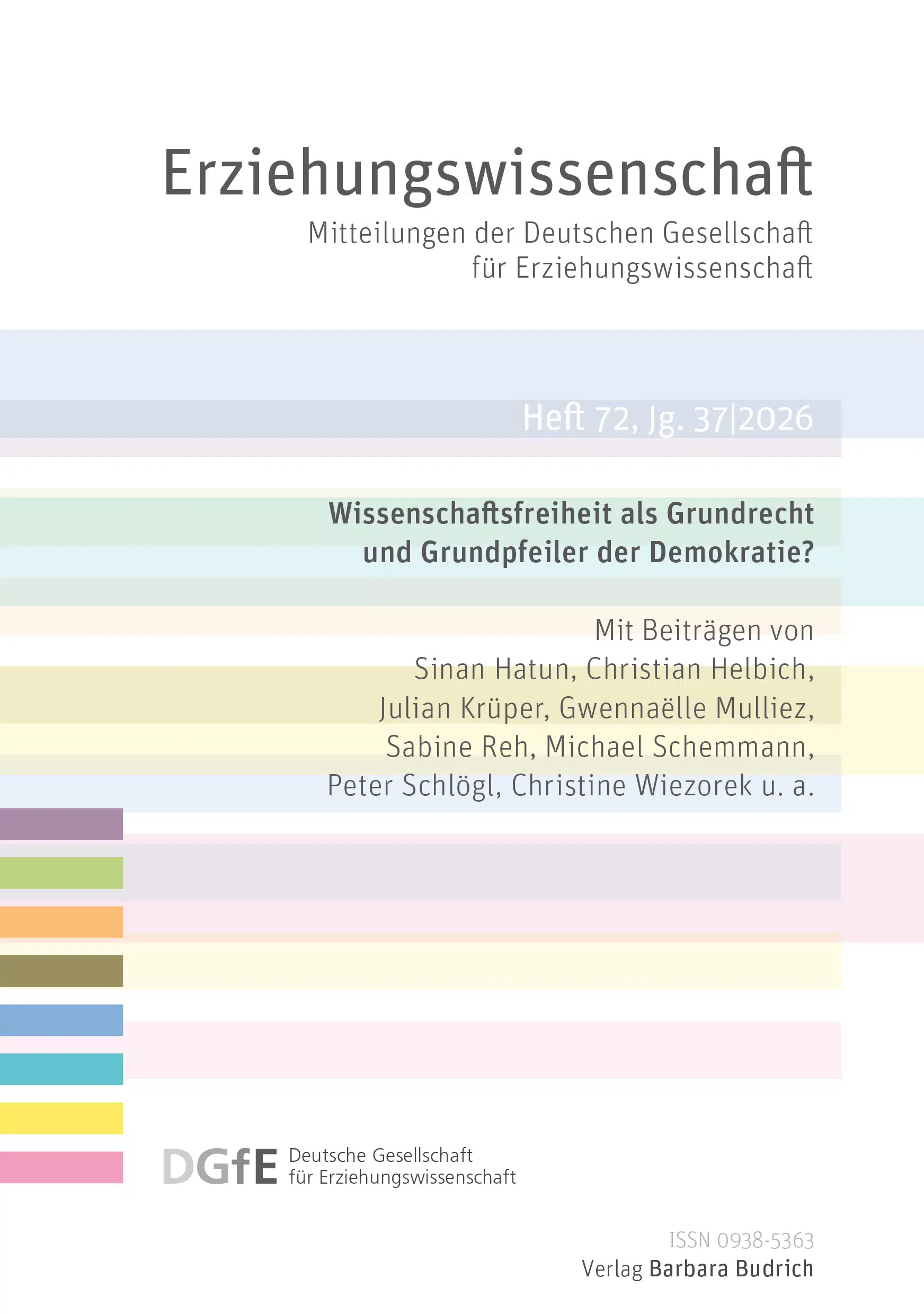
1-2026 (Heft 72): Wissenschaftsfreiheit als Grundrecht und Grundpfeiler der Demokratie?
Editorial
Themenschwerpunkt
Sabine Reh: Bildung und Wissenschaft in Freiheit – bedroht? Historische Rekonstruktionen und theoretische Reflexionen
Peter Schlögl: Zwischen Defensive und aktiver Gesellschaftsgestaltung: Wissenschaftsfreiheit in Österreich
Julian Krüper / Sinan Hatun: Wissenschaftsfreiheit – individuelle, institutionelle und politische Dimensionen
Christian Helbig / Gwennaëlle Mulliez: Wissenschaftsfreiheit als kollektives Ermöglichungsprojekt. Perspektiven von Wissenschaftler:innen in Qualifizierungsphasen
Laudationes
Christine Wiezorek: Laudatio für Prof. Dr. Ralf Bohnsack
Hans-Christoph Koller: Laudatio für Prof. Dr. Dr. h. c. Sabine Andresen
Oliver Böhm-Kasper: Laudatio für Julia Katharina Weiß, M. Sc., und Matthias Bottling, M. Sc
Petra Herzmann / Nicolas Engel: Laudatio für Dr. Susanne Gottuck
Sandra Hofhues: Laudatio für Prof. Dr. Stefan Aufenanger
Elke Kleinau: Laudatio für Prof. Dr. Margarete Götz
Michael Schemmann: Laudatio für Prof. Dr. Elke Kleinau
Mitteilungen des Vorstands
Ethikkodex der Deutschen Gesellschaft für Erziehungswissenschaft (DGfE)
Geschäftsordnung des Ethikrats der Deutschen Gesellschaft für Erziehungswissenschaft (DGfE)
Geschäftsordnung des Ombudsgremiums der Deutschen Gesellschaft für Erziehungswissenschaft (DGfE)
Geschäftsordnung der Kommission zur Forschungsethik der Deutschen Gesellschaft für Erziehungswissenschaft (DGfE)
Christine Wiezorek / Susan Derdula-Makowski: Bericht über die Arbeit der Programmkommission für den DGfE-Kongress 2026
Berichte aus den Sektionen und Arbeitsgruppen
AG Nachhaltigkeit bzw. Nichtnachhaltigkeit und planetare Zukünfte
AG Aufarbeitung der Kommission Sozialpädagogik
Sektion 5 – Schulpädagogik
Sektion 8 – Sozialpädagogik und Pädagogik der frühen Kindheit
Sektion 10 – Pädagogische Freizeitforschung und Sportpädagogik
Sektion 11 – Frauen- und Geschlechterforschung in der Erziehungswissenschaft
Sektion 13 – Differenzielle Erziehungs- und Bildungsforschung
Sektion 14 – Organisationspädagogik
Personalia
Sabine Seichter: Nachruf auf Prof. Dr. Micha Brumlik
Ingrid Gogolin / Mechtild Gomolla: Nachruf auf Prof.in Dr. Marianne Krüger-Potratz
Malte Brinkmann: Nachruf auf Prof. Dr. Wilfried Lippitz
Carola Junghans / Andreas Feindt / Till-Sebastian Idel: Nachruf auf Prof. Dr. Dr. h. c. Hilbert Meyer
Gisela Knaup / Wolfgang Hörner / Dieter Schulz: Nachruf auf Prof. Dr. Dr. h. c. mult. Rita Süßmuth
Einzelbeitrag-Download (Open Access): ew.budrich-journals.de
Sie können sich hier für den EW-Alert anmelden.
Zusätzliche Informationen
| Publisher | |
|---|---|
| ISSN | 0938-5363 |
| eISSN | 1862-5231 |
| Volume | 37. Jahrgang 2026 |
| Edition | 1-2026 |
| Date of publication | 16.07.2026 |
| Scope | 154 Seiten |
| Language | Deutsch |
| Format | 14,8 x 21 cm |
| DOI | |
| Open Access-Lizenz | |
| Homepage |
Additional Content
Autor*innen
Sabine Reh

Peter Schlögl
Julian Krüper
Sinan Hatun
Christian Helbig
Gwennaëlle Mulliez
Christine Wiezorek
Hans-Christoph Koller
Oliver Böhm-Kasper
Petra Herzmann
Nicolas Engel
Sandra Hofhues
Elke Kleinau
Michael Schemmann
Susan Derdula-Makowski
Sabine Seichter
Ingrid Gogolin
Mechtild Gomolla
Malte Brinkmann
Carola Junghans
Andreas Feindt
Till-Sebastian Idel
Gisela Knaup
Wolfgang Hörner
Dieter Schulz
KeywordsBildung, Demokratie, Deutsche Gesellschaft für Erziehungswissenschaft (DGfE), DGfE-Kongress 2026, Juli 2027, Qualifizierungsphasen, Wissenschaft, Wissenschaftsfreiheit, Österreich
Abstracts
Bildung und Wissenschaft in Freiheit – bedroht? Historische Rekonstruktionen und theoretische Reflexionen (Sabine Reh)
The text offers a critical reflection on the concept of academic freedom from historical and theoretical perspectives. It begins with a “liberal founding framework” dating to around 1800, in which education, freedom, and the university—particularly in Humboldt’s thought—are closely intertwined. While this idea still shapes modern understandings of science, it proves insufficient for addressing contemporary debates. Historical analysis shows that academic freedom has never existed without conflict but has always been embedded in tensions between state, society, and institutional structures. Since the 20th century, these conditions have shifted significantly, in part due to the “scientification of the social”: science has become deeply intertwined with political and social processes, generating new conflicts, especially between epistemic freedom and social responsibility. Examples from the 1960s and 1970s illustrate disputes over academic freedom, research control and state intervention. The text concludes that academic freedom should not be seen as a fixed state but as an open, contested space of discourse that requires continuous negotiation and active responsibility.
» Einzelbeitrag kostenlos herunterladen (Budrich Journals)
Zwischen Defensive und aktiver Gesellschaftsgestaltung: Wissenschaftsfreiheit in Österreich (Peter Schlögl)
This paper examines academic freedom in Austria, considering it in terms of the tension between protection against interference and research’s active role in shaping society. Starting from the legal-normative foundation, it illuminates the current situation in Austria and addresses various forms of influence on scientific freedom. Both external and immanent threats to academic freedom are discussed. Drawing on Isaiah Berlin’s distinction between negative and positive liberty, current debates, and recent empirical findings from the 2025 Science Barometer, a nuanced understanding of academic freedom is developed that goes beyond purely instrumental justifications. The paper concludes by advocating for a conception of academic freedom that recognizes both its intrinsic value for critical thinking and its role in dynamic social processes.
» Einzelbeitrag kostenlos herunterladen (Budrich Journals)
Wissenschaftsfreiheit – individuelle, institutionelle und politische Dimensionen (Julian Krüper & Sinan Hatun)
In Germany’s constitutional order, the free pursuit of science, research, and teaching is expressly protected as a fundamental right under Article 5 (3) sentence 1 of the Basic Law. Its professional practice is shaped to a particular degree by state-funded institutions. Furthermore, the academic world is exposed to multifaceted intertwining with politics and the challenges of the “postfactual” age. This article outlines these three interrelated aspects.
» Einzelbeitrag kostenlos herunterladen (Budrich Journals)
Wissenschaftsfreiheit als kollektives Ermöglichungsprojekt. Perspektiven von Wissenschaftler:innen in Qualifizierungsphasen (Christian Helbig & Gwennaëlle Mulliez)
This paper examines academic freedom as a tension between its constitutional promise and its precarious implementation in everyday academic work. Drawing on the 2025 DGfE autumn conference “Academic Freedom as a Fundamental Right and Pillar of Democracy”, it reframes academic freedom not primarily as a defensive right against external political interference, but as a materially and organizationally conditioned practice that is increasingly constrained from within academia.
» Einzelbeitrag kostenlos herunterladen (Budrich Journals)
Inhalt
Inhalt
Educational Science
1-2026 (Heft 72): Wissenschaftsfreiheit als Grundrecht und Grundpfeiler der Demokratie?
Editorial
Themenschwerpunkt
Sabine Reh: Bildung und Wissenschaft in Freiheit – bedroht? Historische Rekonstruktionen und theoretische Reflexionen
Peter Schlögl: Zwischen Defensive und aktiver Gesellschaftsgestaltung: Wissenschaftsfreiheit in Österreich
Julian Krüper / Sinan Hatun: Wissenschaftsfreiheit – individuelle, institutionelle und politische Dimensionen
Christian Helbig / Gwennaëlle Mulliez: Wissenschaftsfreiheit als kollektives Ermöglichungsprojekt. Perspektiven von Wissenschaftler:innen in Qualifizierungsphasen
Laudationes
Christine Wiezorek: Laudatio für Prof. Dr. Ralf Bohnsack
Hans-Christoph Koller: Laudatio für Prof. Dr. Dr. h. c. Sabine Andresen
Oliver Böhm-Kasper: Laudatio für Julia Katharina Weiß, M. Sc., und Matthias Bottling, M. Sc
Petra Herzmann / Nicolas Engel: Laudatio für Dr. Susanne Gottuck
Sandra Hofhues: Laudatio für Prof. Dr. Stefan Aufenanger
Elke Kleinau: Laudatio für Prof. Dr. Margarete Götz
Michael Schemmann: Laudatio für Prof. Dr. Elke Kleinau
Mitteilungen des Vorstands
Ethikkodex der Deutschen Gesellschaft für Erziehungswissenschaft (DGfE)
Geschäftsordnung des Ethikrats der Deutschen Gesellschaft für Erziehungswissenschaft (DGfE)
Geschäftsordnung des Ombudsgremiums der Deutschen Gesellschaft für Erziehungswissenschaft (DGfE)
Geschäftsordnung der Kommission zur Forschungsethik der Deutschen Gesellschaft für Erziehungswissenschaft (DGfE)
Christine Wiezorek / Susan Derdula-Makowski: Bericht über die Arbeit der Programmkommission für den DGfE-Kongress 2026
Berichte aus den Sektionen und Arbeitsgruppen
AG Nachhaltigkeit bzw. Nichtnachhaltigkeit und planetare Zukünfte
AG Aufarbeitung der Kommission Sozialpädagogik
Sektion 5 – Schulpädagogik
Sektion 8 – Sozialpädagogik und Pädagogik der frühen Kindheit
Sektion 10 – Pädagogische Freizeitforschung und Sportpädagogik
Sektion 11 – Frauen- und Geschlechterforschung in der Erziehungswissenschaft
Sektion 13 – Differenzielle Erziehungs- und Bildungsforschung
Sektion 14 – Organisationspädagogik
Personalia
Sabine Seichter: Nachruf auf Prof. Dr. Micha Brumlik
Ingrid Gogolin / Mechtild Gomolla: Nachruf auf Prof.in Dr. Marianne Krüger-Potratz
Malte Brinkmann: Nachruf auf Prof. Dr. Wilfried Lippitz
Carola Junghans / Andreas Feindt / Till-Sebastian Idel: Nachruf auf Prof. Dr. Dr. h. c. Hilbert Meyer
Gisela Knaup / Wolfgang Hörner / Dieter Schulz: Nachruf auf Prof. Dr. Dr. h. c. mult. Rita Süßmuth
Einzelbeitrag-Download (Open Access): ew.budrich-journals.de
Sie können sich hier für den EW-Alert anmelden.
Bibliography
Zusätzliche Informationen
| Publisher | |
|---|---|
| ISSN | 0938-5363 |
| eISSN | 1862-5231 |
| Volume | 37. Jahrgang 2026 |
| Edition | 1-2026 |
| Date of publication | 16.07.2026 |
| Scope | 154 Seiten |
| Language | Deutsch |
| Format | 14,8 x 21 cm |
| DOI | |
| Open Access-Lizenz | |
| Homepage |
Produktsicherheit
Additional Content
Additional Content
Bewertungen (0)
Bewertungen
Es gibt noch keine Bewertungen.
Authors
Autor*innen
Sabine Reh
Peter Schlögl
Julian Krüper
Sinan Hatun
Christian Helbig
Gwennaëlle Mulliez
Christine Wiezorek
Hans-Christoph Koller
Oliver Böhm-Kasper
Petra Herzmann
Nicolas Engel
Sandra Hofhues
Elke Kleinau
Michael Schemmann
Susan Derdula-Makowski
Sabine Seichter
Ingrid Gogolin
Mechtild Gomolla
Malte Brinkmann
Carola Junghans
Andreas Feindt
Till-Sebastian Idel
Gisela Knaup
Wolfgang Hörner
Dieter Schulz
Tags
KeywordsBildung, Demokratie, Deutsche Gesellschaft für Erziehungswissenschaft (DGfE), DGfE-Kongress 2026, Juli 2027, Qualifizierungsphasen, Wissenschaft, Wissenschaftsfreiheit, Österreich
Abstracts
Abstracts
Bildung und Wissenschaft in Freiheit – bedroht? Historische Rekonstruktionen und theoretische Reflexionen (Sabine Reh)
The text offers a critical reflection on the concept of academic freedom from historical and theoretical perspectives. It begins with a “liberal founding framework” dating to around 1800, in which education, freedom, and the university—particularly in Humboldt’s thought—are closely intertwined. While this idea still shapes modern understandings of science, it proves insufficient for addressing contemporary debates. Historical analysis shows that academic freedom has never existed without conflict but has always been embedded in tensions between state, society, and institutional structures. Since the 20th century, these conditions have shifted significantly, in part due to the “scientification of the social”: science has become deeply intertwined with political and social processes, generating new conflicts, especially between epistemic freedom and social responsibility. Examples from the 1960s and 1970s illustrate disputes over academic freedom, research control and state intervention. The text concludes that academic freedom should not be seen as a fixed state but as an open, contested space of discourse that requires continuous negotiation and active responsibility.
» Einzelbeitrag kostenlos herunterladen (Budrich Journals)
Zwischen Defensive und aktiver Gesellschaftsgestaltung: Wissenschaftsfreiheit in Österreich (Peter Schlögl)
This paper examines academic freedom in Austria, considering it in terms of the tension between protection against interference and research’s active role in shaping society. Starting from the legal-normative foundation, it illuminates the current situation in Austria and addresses various forms of influence on scientific freedom. Both external and immanent threats to academic freedom are discussed. Drawing on Isaiah Berlin’s distinction between negative and positive liberty, current debates, and recent empirical findings from the 2025 Science Barometer, a nuanced understanding of academic freedom is developed that goes beyond purely instrumental justifications. The paper concludes by advocating for a conception of academic freedom that recognizes both its intrinsic value for critical thinking and its role in dynamic social processes.
» Einzelbeitrag kostenlos herunterladen (Budrich Journals)
Wissenschaftsfreiheit – individuelle, institutionelle und politische Dimensionen (Julian Krüper & Sinan Hatun)
In Germany’s constitutional order, the free pursuit of science, research, and teaching is expressly protected as a fundamental right under Article 5 (3) sentence 1 of the Basic Law. Its professional practice is shaped to a particular degree by state-funded institutions. Furthermore, the academic world is exposed to multifaceted intertwining with politics and the challenges of the “postfactual” age. This article outlines these three interrelated aspects.
» Einzelbeitrag kostenlos herunterladen (Budrich Journals)
Wissenschaftsfreiheit als kollektives Ermöglichungsprojekt. Perspektiven von Wissenschaftler:innen in Qualifizierungsphasen (Christian Helbig & Gwennaëlle Mulliez)
This paper examines academic freedom as a tension between its constitutional promise and its precarious implementation in everyday academic work. Drawing on the 2025 DGfE autumn conference “Academic Freedom as a Fundamental Right and Pillar of Democracy”, it reframes academic freedom not primarily as a defensive right against external political interference, but as a materially and organizationally conditioned practice that is increasingly constrained from within academia.
» Einzelbeitrag kostenlos herunterladen (Budrich Journals)
 English
  German
Bewertungen
Es gibt noch keine Bewertungen.